
An excerpt from the forthcoming book “Organizing and Managing Insanely Great Products” by David Fradin with RN Prasad
Innovation management p1
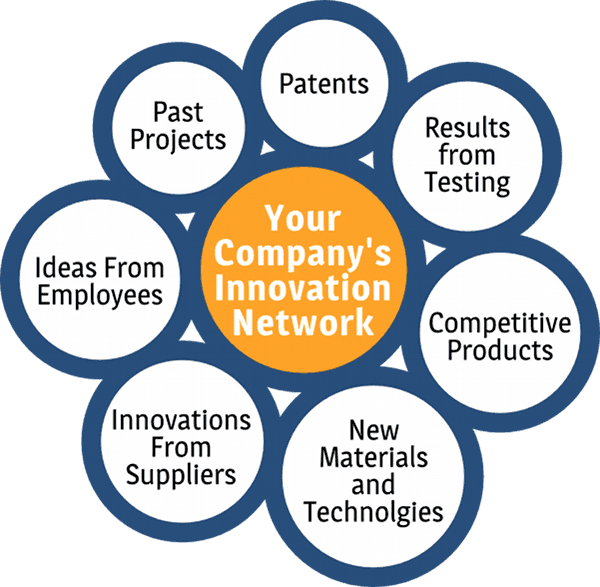
In this section, I will discuss how to manage innovation, the cost of advanced technology, change oriented innovation, and all of the strategic management options.
Innovation is solving real problems fast, better, and perhaps at a lower cost. Design, like the Apple Watch, thus creating a style, is also innovation. It is creating real value for real or in the mind of the customer. Because innovation is valuable, one has to manage it effectively, and that is what this section is all about.
In his book, “Innovations Tools” ( Innovation Tools https://amzn.to/2Wp3Vbo) author Evan Shellshear outlines the six innovation tools that are the most effective. They are:
- Crowdsourcing
- Crowdfunding
- Open Source
- Hackerspaces
- Maker Faires
- Open Innovation
Get the book if you want to learn more about how to innovate effectively.
One of the first things an organization can do is an Intellectual Property (IP) Audit to identify and perhaps value the IP the organization currently owns, desires to acquire, and learn how each IP is being managed. Then the recommendations of the IP audit should be implemented, and any new processes developed and deployed should be monitored.
Managing Innovation
Accenture identifies seven characteristics of managing innovation:
- Hyper Relevant: Sensing and addressing the changing needs of customers.
- Technology Propelled: Mastering leading-edge technologies that drive innovation.
- Data-Driven: Deliver new product and service innovations safely.
- Asset Smart: Adopting intelligent asset and operations management to ensure businesses run efficiently.
- Inclusive: Adopting an inclusive approach to innovation and governance.
- Talent Rich: Adapting to the changing expectations and trends in the workforce to gain a competitive advantage with top talent.
- Inclusive: Incorporating a broader range of stakeholders.
Accenture studies have found those companies that are having the greatest success use this approach:
- CHANGE-ORIENTED: Have the courage to apply innovation with greater intensity to reinvent existing ways of working, and thus achieve deep organizational change.
- OUTCOME-LED: Foster innovation efforts across the business, and have the discipline to tie them rigorously to financial performance.
- DISRUPTION-MINDED: Commit to investing more aggressively, over time, in truly disruptive innovation initiatives that have the potential to create entirely new markets.
Cost of Advanced Technology
The cost of technologies like cloud computing and storage, batteries, solar panels, wind plants, drones, bandwidth, 3D printing, genome sequencing has been rapidly declining over the past twenty years. This will lead to even more significant innovations like for example the advent of cloud computing over the past ten years and smartphones for about the same period. Without both services such as Lyft and Uber would not exist.
Change Oriented Innovation
Accenture tested innovation practices and found these ones were key:
- Ability to grow the capabilities of the senior leadership to oversee innovation-led change
- Focus on enabling small cross-disciplinary teams to work on innovation projects
- Use of design thinking to develop products and services that revolve around customer experience
- Collaboration with customers during the innovation process to identify the high potential commercial opportunities
- Application of cognitive agents/virtual advisers (based on artificial intelligence) in customer-facing activities
- Use of new-venture vehicles, such as CVC, accelerators, and incubators, and idea labs, to accelerate innovation
They also found that companies apply these innovation practices in these ways:
- HYPER RELEVANT
Knowing how to be – and stay – relevant by sensing and addressing customers’ changing needs.
- NETWORK POWERED
Harnessing the power of a carefully managed ecosystem of partners, to bring the best innovations to your customers.
- TECHNOLOGY PROPELLED
Mastering leading-edge technologies that enable business innovation.
- TALENT RICH
Creating new, modern forms of workforces (flexible, augmented, and adaptive) to gain a competitive advantage in fast-changing markets.
- DATA-DRIVEN
Generating, sharing, and deploying data to deliver new product and service innovations safely and securely.
- INCLUSIVE
Adopting an inclusive approach to innovation and governance that incorporates a broader range of stakeholders.
- ASSET SMART
Adopting intelligent asset and operations management to run businesses as efficiently as possible, and to free up the capacity for other innovative efforts.
Companies have found that innovation can also be applied to their operations, creating an even higher growth and ROI.
Strategic IP management options
Intellectual Property (IP) usually consists of patents, trademarks, copyrights, and trade secrets. Some of this varies depending upon the country.
Sometimes the best strategic IP management decisions are hampered by the functional silos between managers, lawyers, and product developers, including product management. The silos need to be overcome.
The ways to manage IP are:
- Use IP rights to suppress the competition
- Sell
- License
- Collaborate
- Donate
- Pursue other objectives
Open vs. Closed
The Apple // had eight slots and development software available so it could be turned into practically anything the ecosystems wanted to create. They did word processing to industrial machine control. That open innovation strategy was so good, IBM copied this strategy with the IBM PC.
However, under Steve Job’s guidance, the LISA and the Mac had no slots and was a closed system. LISA went so far as to have no interest in outside developers, and in its entire life from 1983 to 1985 had only seven applications written exclusively by Apple. That contributed to its failure. Customers wanted a $10,000 computer ($30,000 today) to do more than just seven things.
The Mac also had no slots following Steve’s predisposal to total control. I think at that time (I was at Apple then running the Apple /// Independent Business Unit), Steve was mostly interested in power.
Later, when he came back to Apple in 1997, that desire for total control shifted slowly into controlling the entire customer experience. Which was good and perhaps lead the “customer-centric” business model many are now implementing.
There was more openness with the Mac by allowing third parties to write applications for it. Later, after Steve left in 1985, future Macs had slots like the Apple // and the Apple ///. Then after the first couple of generations of the iPhone, Steve allowed the creation of the App Store. This openness helped with the iPhone’s success. Closeness is a significant limitation of market power. One must be very careful, trying to implement closeness. It might backfire.
Indirect Network Effects: Ecosystem
Having an ecosystem like Apple’s is an effective way of managing IP. Ford Motor did this when they first started. It was called vertical integration then by owning the iron ore mines, to the ships, steel furnaces, metal parts stamping plants, and so forth.
Competitors may form strategic partnerships to compete. For example, as I write this in mid-2019, Samsung and Microsoft just announced a strategic alliance to compete with the iPhone ecosystem.
Competitors might use price to counter an ecosystem and thus drive down your profit if you choose to compete on price.
Competition
It is frequently said that if there are no competitors, then there is no market. Also, competitors help with educating the market.
When IBM joined the PC market in 1981, less than 4% of the total available market had a PC. Many wondered why they needed a PC. Not unlike Watson, the president of IBM, spoke of the size of the computer market in the early 1940s to be no more than six computers.
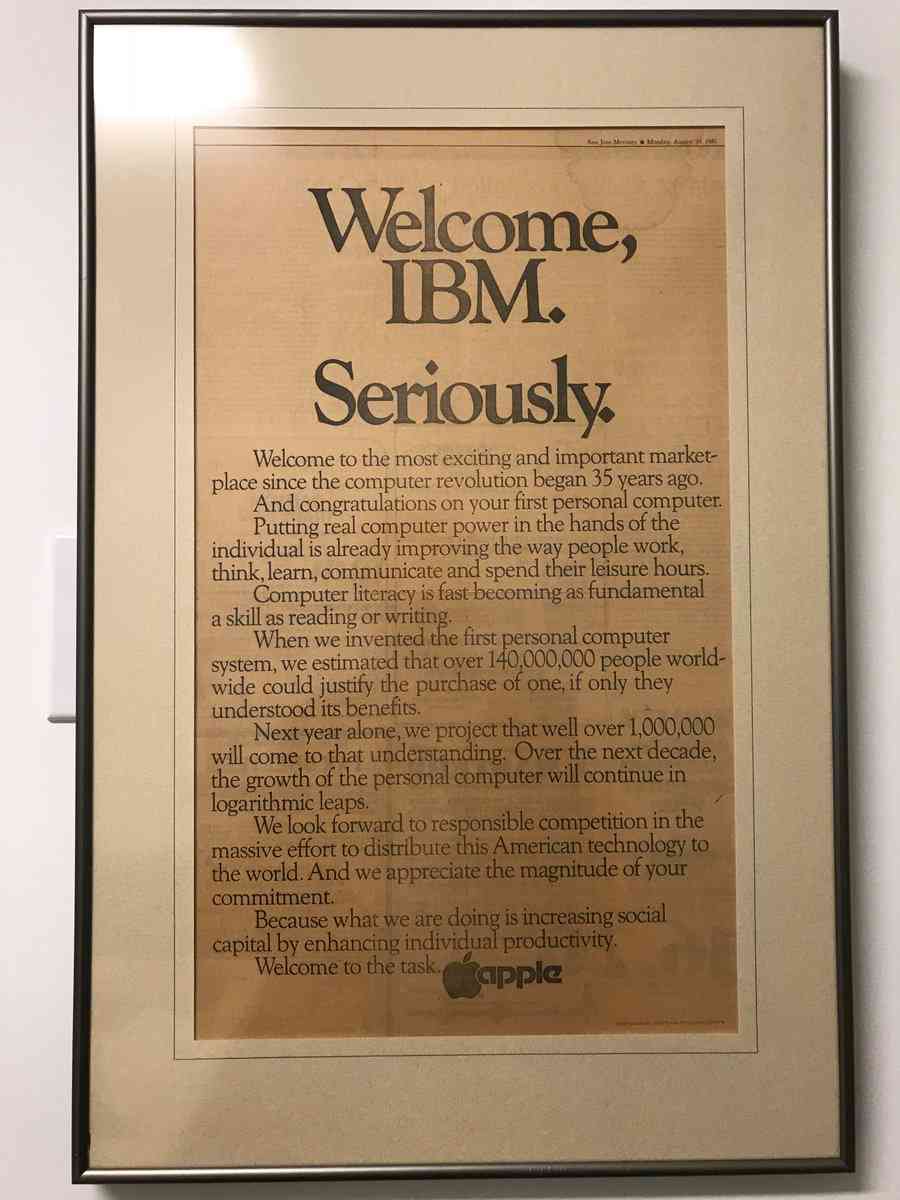
Today well over 90% of people own PCs in the USA. In 1980 Apple was so happy that IBM had entered the market, they ran a full-page ad in the Wall Street Journal “Welcome IBM, Seriously.” Apple was delighted that IBM was now there lending credibility to the market. This was, at the time, when IBM protected its IP with FUD or Fear, Uncertainty and Doubt and famously was quoted that nobody gets fired by buying IBM.
However, many questioned Apple’s rationale of welcoming such a giant into its market. As Apple’s VP of Communications (Advertising and PR) Fred Hoar said in many a speech that running that ad was a lot like agreeing to play catch with a javelin and electing to catch. Apple’s decision to run that ad was a good one and contributed to the company’s continuing growth. It was during that time I was there, Apple grew from sales of $400 Million per year to over $2 Billion.
Sell your IP
By selling your IP it’s an excellent way to get a return on your investment. Apple recently bought Intel’s mobile modem business for $1 Billion.
Kodak, literally having missed the digital revolution from film to digital film (by defining their business as the still and moving film business instead of the business of capturing, storing, retrieving and displaying images business), is now worth less than $1 Billion (down from $31 B in 1996). Since then, they have been busy licensing and selling off Kodak’s IP portfolio.
Licensing your IP
If you don’t have the resources to build, market, sell, and support your IP, then you could license it to an entity that does have the resources. ARM does this and sells billions of microprocessors each year.
Google, for example, offers its Android licensing for free. The idea is to get more eyeballs for Google’s search so they can sell more advertising and to pre-install Google’s Mobile apps to get even more impressions for advertising. This gives Google immense influence over the smartphone market without also manufacturing its own phone. Which it is now again trying to do after first failing by itself and failing still with Motorola’s mobile unit which they bought and later dumped.
Collaboration
If two parties would like to use each other’s IP, they could cross-license. Another form is to collaborate on setting standards. In 2018, Facebook, Google, Microsoft and Twitter joined forces to enable one to take their social media data and go to a different platform.
Called the Data Transfer Project it is in response to data privacy issues like Cambridge Analytics/Facebook/Russia during the 2016 US elections and coming regulations from the EU and the US.
At the time of this writing, the Republican US Senate Intelligence Committee is circulating a white paper suggesting this ability might be required by law sometime in the future. Apple has now signed on too.
There are many cross collaborations between multiple car and transportation companies in the autonomous vehicles market also.
Donate
Another way to manage your IP would be to donate it. Google did this with Android, perhaps to protect being locked out of mobile search traffic if Apple decided to use a different search engine on its iPhone. Open-source initiatives like Unix and Linux are similar.
End of Life
Customer loyalty to the company and the company’s loyalty to the customer is a two-way street.
It is sort of like getting married.
If the company does not provide loyalty to the customer, then the customer has a trigger point generated in their customer journey to look for alternatives. In other words, a divorce.
When I took over the Apple /// as the independent Business Unit Manager (BUM) in the last year of the product’s life, I researched what needs to be done to end of life the product.
I found that there was only one other product in the history of Silicon Valley at that time that had ever had a managed end of life process. Previously Silicon Valley companies just stopped making and supporting their products when they became unprofitable, or the company thought they should kill it.
The first product to have a managed end of life was the HP 300 minicomputer, and its manager was a fellow by the name of David Crocket. I tracked him down and had lunch with him and a few of my people working for me. The critical thing David taught me to do is to make sure that all of the customers were not left high and dry. Take care of them, he said. Follow the Apple and HP values of empathy for the customer.
Knowing that the real value of my customers Apple ///s was not the computer and its accessories itself. It was their data. During the time I was at HP, I was taught over and over again to protect the customer’s data. Later, when I bought a new Motorola cell phone and found I had to key in my 4,000 contacts one by one again because I was upgrading to another Motorola phone, I started looking for a new brand. They blew my brand loyalty.
So with the Apple /// I organized an effort to get the over 500 software and hardware developers to migrate their products to the Macintosh then currently under development. My connection with the Mac was the evangelist Guy Kawasaki, the writer, entrepreneur, and venture capitalist. That way say an accounting package was ported to the Mac, then the developer will probably (and I encouraged) also ship a means of transferring the customer’s accounting data from the Apple /// to the Mac. I sought to protect the customer’s data. It worked. Many of my Apple /// customers were happy with my plan and stayed with Apple. When they were ready, they moved on from the Apple /// to the Mac.
Steve Jobs, on the other hand, abruptly canceled the Lisa line of computers when he was given the management of the Lisa Division in addition to the Mac Division. The $10,000 Lisa customers were pissed, and the stock market punished the stock price and Apple’s investors.
If I hadn’t done that Apple would probably have lost all of its 75,000 Apple /// owners to IBM PCs. In effect, I managed the transfer of Apple /// IP to Mac IP.
Here is another example. In 2009, Cisco bought the Flip camera thinking that videos are a lot of bits and bytes to be moved around on Cisco networks. Perhaps they did not realize that much of Cisco’s IP and management talent was business to business-oriented, and Cisco’s senior management had little business to customer experience. So Cisco shut down the business just two years later, and the only thing they did to ensure customer loyalty was to run the Cloud storage service for another year or so.
I’ve talked to several Flip camera owners, and they all said they would never buy another Cisco product again. The real value of the Flip camera was not the camera itself. Cameras were becoming ubiquitous on smartphones at the time. The real value was the Cloud storage, retrieval, and display of videos. Cisco could have become a rival to YouTube. Camera extensions could have become similar to Go camera ecosystem.
However, Cisco mismanaged this IP and did not benefit and did harm the company. Perhaps not so much since its customers are internet service providers, IT departments, and carriers. However, maybe one of those customers was also a Flip camera owner; they might have a bit of risk concern that Cisco might just discontinue a product they had bought, again.
Summary
Accenture identifies seven characteristics of managing innovation and three approaches. The cost of advanced technology is rapidly declining thus accelerating innovation. The strategic IP management options are suppression, sell, license, collaborate, donate, pursue other objectives.
Additional Reading
https://en.wikipedia.org/wiki/Innovation_management
https://hbr.org/2006/02/the-why-what-and-how-of-management-innovation
Podcast: Play in new window | Download (Duration: 18:51 — 34.5MB) | Embed
1 Comment
Leave a Comment

David on Building Great Products, AI and Tech Shifts
By David Fradin |

Untold Stories From the Early Days of Apple Computer
By David Fradin |

Product Success Issues: Uses of Artificial Intelligence in Product Success Management
By David Fradin |

[…] Innovation management […]