



When you do your competitive analysis of the market environment, you must look at both the product vs. product and the company vs. company comparisons. Many forget to do the company vs. company comparison. Suppose you were planning on entering a new market and would need to build a distribution channel. If you don’t do a competitive analysis on your competing companies, what do you think will happen if you only find out after you have entered the market? Suppose that you find out your competitor has some kind of monopoly on the distribution channel? It is much better to know that before one of your salespeople calls you and says the target reseller is already carrying a similar product.
When to Compare
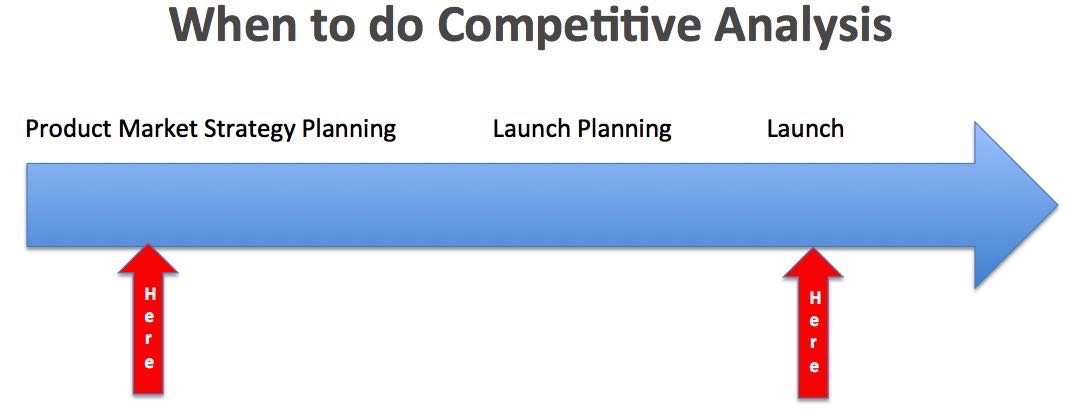
In this section, we will discuss when to do the competitive analysis, what should be included and what things to look for in the competitive research.
Typically, competitive analysis is done as part of the planning process, but it should also be repeated around the projected time of launch. First you forecast where you think your competitors’ products and companies will be at the time you expect to be launching your product. Secondly, do your comparison at that point in time.
The reason is obvious: suppose your competitor comes out with a new version, changes their price, runs a promotion, adds distribution, forms a new partnership and so forth between the time you do the analysis and when you launch. This changes the environment at launch time and you need to take those changes into account.
Also, notice if your competitors seem to have an effort in place to be creating insanely great customers. See the section about “Creating Insanely Great Customers” for more information. If they do, you will have to beat them at that as well.
Do the comparison in terms of what problems their product is solving because, after all, when a customer goes shopping, they are looking for products that solve their problems or needs. They are not, in general, looking for just a feature.
Company vs. Company Comparison
When you do your company vs. company competitive comparison and analysis, do it in terms of the six keys of success discussed.
Remember the mnemonic? — SPICES.
- What is their Strategy?
- What are their Processes?
- What Information do they have?
- Who are their Customers, and are they satisfied?
- How good and how well trained are their Employees?
- What Systems and tools are they using?
Some of this you can learn from their website and some sites like Glassdoor, etc. Customer satisfaction can be discovered by looking at their product reviews online. Ask market research companies if your competitor subscribes to or buys their reports, and attends their conferences. When you interview at the company you are interested in, ask the HR department representative what kind of training they provide. Ask systems and tools vendors if your competitor is one of their customers.
Here are some other areas you should research:
What are their company values? You can probably find them on their website. Is there a mismatch? What is the company’s vision for the markets they are targeting, across the board. Likewise, that would be on their website.
Are they going after a market they have no presence in, or are real strong?
What is their distribution like? How are they going to market (direct, indirect, hybrid)? What kind of distribution channels do they use, and how saturated are these channels (direct via their own salesforce and/or online, indirect via distributors, reps, catalog houses)?
Are they vertically integrated? Do they use a vertical target approach? Do they ship product themselves, or do they use fulfillment centers? Are they using third-party online retailers such as Amazon, Walmart, etc?
Place an order for their product and notice how fast it arrives, how it is packaged, what kind of marketing material is inside, what other pull-through promotions they are using, and if there is an incentive provided for returning customers.
What is their brand and business model? What are the background, training and experience of their management? Many times this information is available on their website.
Frequently, I see senior managers of companies who have no experience with the kind of business they are doing. This becomes an opportunity if you do have experience and perhaps connections that they do not posses. They seem to think that since they were successful in one business market they will be 100% successful in another. In reality, many of them will ultimately fail.
For example, Jim McNeill uses tools such as subscription services (CIRadar) that feed him information daily based on criteria he has set. He also monitors Twitter feeds and related info with HootSuite, mines LinkedIn for competitive information regarding turnover, and even tries to seek out ex-employees for feedback.
Systems in the competitive analysis means do they have the systems in place such as IT systems to manage their product’s operations, marketing, customer service, etc. Buy something from them and see how they perform order fulfillment, including calling them with a support issue to check out their service processes and effectiveness. If they do have good systems in place, you will have to match them or do better than them, or they will run circles around you with better implementation.
Process means they have developed and implemented processes to run their business. You can tell if they have processes in place if they regularly crank out updates and/or new products that work and are well supported.
Information means that it seems they have the information they need to run their business. You can tell from their public utterances. Observing how fast they respond to market changes will tell us how fast the market information is being processed inside their company, and how agile their processes are.
Apple has this nailed with the now regular releases of new phones, iPads, etc.
Creating Insanely Great Customers means are they engaging customers who are defining the future for their industry. One way to tell if a company is trying to do this is to research whether or not they have a “voice of the customer” program and/or are doing primary market research? Do they have customer advisory boards? In other words, who is doing a better job of engaging them: you or your competition?
Do they have a tiered distribution channel (A-, B-, C-level customers)? Do they engage with their A-level customers in developing next-generation products? This information is harder to find, but industry insiders or multi-line distributors have that information.

David on Building Great Products, AI and Tech Shifts
By David Fradin |

Untold Stories From the Early Days of Apple Computer
By David Fradin |

Product Success Issues: Uses of Artificial Intelligence in Product Success Management
By David Fradin |

TESTIMONIALS

"I have done the marketing plan and got a great score from my working company. Thanks for your course and coaching."
Hsitang L
Student
"Very interesting course on the effective use of Social media in marketing. Must for all the Product Marketing managers. Simple & effective delivery of content. Thanks, Professor David."
Karthik S
Student
"Excellent Course for Marketing Strategy. It was comprehensive, easy to follow, and had the perfect balance of hands-on activities and lectures that left me with a full marketing strategy and implementation plan at the end of the course. Great course for anyone starting from scratch."
Spencer J.
Student
"David’s key Product Management and presentations skills were key to my success in starting up and building Apple Pacific in the early 80s."
Sami A
Client
"David continues to be a valued resource for general marketing expertise, industry knowledge, and product marketing know-how. We reference his clear insights regularly."
Peter M
Client
"David has been an excellent coach and mentor. Very detail oriented and practical in his approach. His ideas and frameworks are simple, practical and easy to understand and adopt, being extremely effective at the same time. The concept of ‘Do, value proposition’ is one such excellent framework which not only helps in formulating compelling value proposition for the customers but is also a source of ideas for new product innovation."
Manish B.
Student
"David is a very experienced and talented business professional. I have witnessed this first hand, as has demonstrated his ability across multiple disciplines, including market analysis, segmentation, customer profiling, competitive reviews, product management, marketing and sales strategy development and execution, to name but a few. In addition, he has great communication skills."
Mike B, Lead Generation Consultant
Client
"I met Dave through a consulting engagement while I was at YouSendIt. It was easily the single most useful and insightful consulting engagement I’ve experienced in my career. From his analysis of our industry to the product recommendations, Dave gave us actionable information that made YouSendIt a better company."
Chris B. (YouSendIt)
Client
"Building Insanely Great Products" is a great Segway into the product management space and contains insightful and practical advice which I am now going to validate with some of the projects I am working on"